AI
Dallas College AI Institute
Texas higher education · Established 2026

Set the standards.
Share the work.

The Dallas College AI Institute is Texas higher education's working AI governance body. We graduate AI-fluent students, equip member colleges with the frameworks the law requires, and write the standards the field adopts.

Students at Dallas College
14
Member institutions
Texas community and regional colleges in the consortium.
9
Publications in 2026
Annual report, policy briefs, and framework releases.
60+
Convening attendees
Institutions at the 2026 Texas Higher Education AI Convening.
3
Frameworks mapped
NIST AI RMF, ISO 42001, and TRAIGA.
In the press The New York Times Puck News Inside Higher Ed The Chronicle of Higher Education Dallas Morning News EDUCAUSE Review
In partnership with

The Institute works alongside the field.

Industry partners shape the curriculum and absorb the graduates. Field partners connect the work to standards bodies, peer institutions, and the foundations that fund the future of higher education.

Industry partners
Microsoft
Google Cloud
NVIDIA
Anthropic
AT&T
Texas Instruments
Field partners
EDUCAUSE
THECB TEXAS HIGHER ED COORD. BOARD
AACC AMER. ASSOC. COMMUNITY COLLEGES
League FOR INNOVATION
lumina FOUNDATION
TACC TEXAS ASSOC. COMMUNITY COLLEGES
01 / The work in front of us

What we're solving.

The Institute exists because the field is moving faster than any single college can move with it. Five problems, five places the Institute does the work nobody else is positioned to do.

Problem 01
Compliance is moving faster than colleges can build for it.
TRAIGA. HB 3512. Federal AI policy. Accreditor guidance. The rules are arriving in months, not years. Most Texas colleges do not have legal staff who can read these statutes and translate them into operating practice. Without help, the gap widens, the audits get harder, and the boards get nervous.
How we answer
A versioned compliance pack and a framework that moves when the law moves.
Problem 02
Faculty are being asked to teach something no one is teaching them.
AI is already in the classroom, reshaping how students write, research, and submit work. Faculty across disciplines are doing the work of figuring this out alone, often after class. The result is uneven, anxious, and unsustainable. The people we ask the most of are the ones we leave least supported.
How we answer
A paid Faculty Fellowship, a shared curriculum library, and workshops where faculty stop being on their own.
Problem 03
Boards are asking AI questions with no good answer in front of them.
Trustees ask presidents and chancellors what the AI program looks like. Most can describe a vendor list. Few can describe a control register, an audit trail, or a board-reported metric. The question gets repeated. The answer needs to land. Without governance materials built for trustees, the answer keeps not landing.
How we answer
A quarterly board reporting pack designed to be read once and understood.
Problem 04
Every college is rebuilding the same thing in isolation.
Across Texas, dozens of institutions are quietly writing AI policies on their own. The same policy. The same templates. The same questions to the same lawyers. HB 8 explicitly funded the shared-services lane. Nothing has kept the field there. The work is duplicated and the standards drift apart.
How we answer
A consortium that does the work once, well, and licenses it across the network.
Problem 05
Employers want AI-fluent graduates but cannot tell who is.
North Texas employers signal heavy demand for AI-skilled workers but cannot tell a credentialed graduate from a self-taught one. Without a recognized credential, the workforce promise stays soft. Without employer signal, the credential stays academic. Both sides need a stamp that means the same thing on both sides of the hire.
How we answer
Credentials co-designed with the Industry Partner Council and accepted into the workforce.
A working answer to artificial intelligence in higher education, built where the work already happens.
Dallas College AI Institute
02 / The Institute

Who we are.
Who we serve.

The Institute is a working unit of Dallas College, dedicated to artificial intelligence in higher education. We do the work in the open, on behalf of students, faculty, and peer institutions.

What we are

A working AI governance body, hosted by Dallas College and operating across the College's seven campuses.

The program runs in production. Standards are tested by use, not by intention, and are then made shareable so peer institutions adopt them.

Who we serve

Students earning AI-fluent credentials. Faculty teaching with and about artificial intelligence.

Member institutions meeting state obligations without standing up their own AI office. Employers hiring graduates who know what they are doing.

Students
AI literacy as a graduation requirement. Stackable credentials from a Fluency Certificate to an Applied AI associate degree, mapped to HB 8 outcomes and aligned with employer demand.
Faculty
A paid year-long Fellowship to redesign a course with AI, plus a working library of curriculum and a faculty-only network across member institutions.
Member colleges
A ready governance program. The framework, the policies, the training, the board pack, and the compliance materials. Updated as the law moves.
Industry partners
A pipeline of credentialed talent and a seat at the Industry Partner Council, where employers shape the curriculum and signal where the work is moving.
Texas higher ed
The standards the field adopts. The Institute publishes, convenes, and benchmarks so every Texas institution has a working answer to what governance looks like.
The public
Open materials. Frameworks, policy briefs, and reports the Institute publishes are public goods. Members get the tools and the support; everyone can read the work.
03 / Dallas Twin

A working digital twin of Dallas. With AI woven through.

The Institute operates a continuously updated digital twin of the Dallas metropolitan region. It is where the Institute's AI governance framework gets tested in applied use, where students and faculty do research with real regional data, and where civic partners model the consequences of decisions before making them.

V · CIVIC IV · ECONOMIC III · POPULATION & LEARNING II · WORKFORCE I · SPATIAL

Five layers. One region. AI throughout.

From a continuously refreshed map of streets and infrastructure to real-time workforce signals, anonymized learning outcomes, regional economic indicators, and selected civic operational data, the twin assembles the picture that no single college, agency, or employer can hold on its own.

Explore the twin →
04 / Consortium

A working resource for the colleges that cannot build it alone.

HB 8 created the lane. The Institute occupies it. Membership delivers the governance framework, model policies, training, and the materials a college needs to satisfy state obligations without standing up its own AI office.

Dallas College HOST INSTITUTION MEMBER INSTITUTION HOST · DALLAS COLLEGE
Member institutions
14
Texas community and regional colleges in the consortium, from rural single-site colleges to large multi-campus systems.
Annual membership
$25K – $75K
Tiered by institution size. Membership held through Dallas College Enterprise Ventures.
Mapped to
3 frameworks
NIST AI RMF, ISO 42001, and TRAIGA.
Consortium detail →

Explore the Institute.

Read about the Institute, the twin we operate, the credentials we issue, and the consortium that puts it all in the hands of Texas higher education.
About

Why an Institute,
and why now.

Texas higher education has a new lane and a new obligation. The Institute occupies both, and makes Dallas College the place where the standards get written.

Class of 2026
01 / The case

The lane HB 8 created.

House Bill 8 redirected Texas community college funding toward outcomes and credentials of value, and actively encourages colleges to share services rather than rebuild them in parallel. Artificial intelligence governance is the clear shared service: high stakes, high cost, and far beyond what most colleges can carry alone.

The compliance horizon

The Texas Responsible Artificial Intelligence Governance Act, House Bill 3512, and the federal posture together create a compliance load that arrives whether or not a college is ready. Boards ask the questions. Auditors ask them next.

The Institute carries Dallas College's program and packages it so peer institutions meet the same obligations without standing up their own. The framework runs to NIST AI RMF, ISO 42001, and TRAIGA.

Why Dallas College

Dallas College operates at the scale where AI policy has to be real. Seven campuses. A statewide reach. The systems and the stakes are large enough that the standards are tested by use, not by intention.

The College's mission, scale, and regional employer connections make it the natural home for a Texas-wide Institute. The Institute names what is happening and gives it a home.

Footprint

Where the work happens.

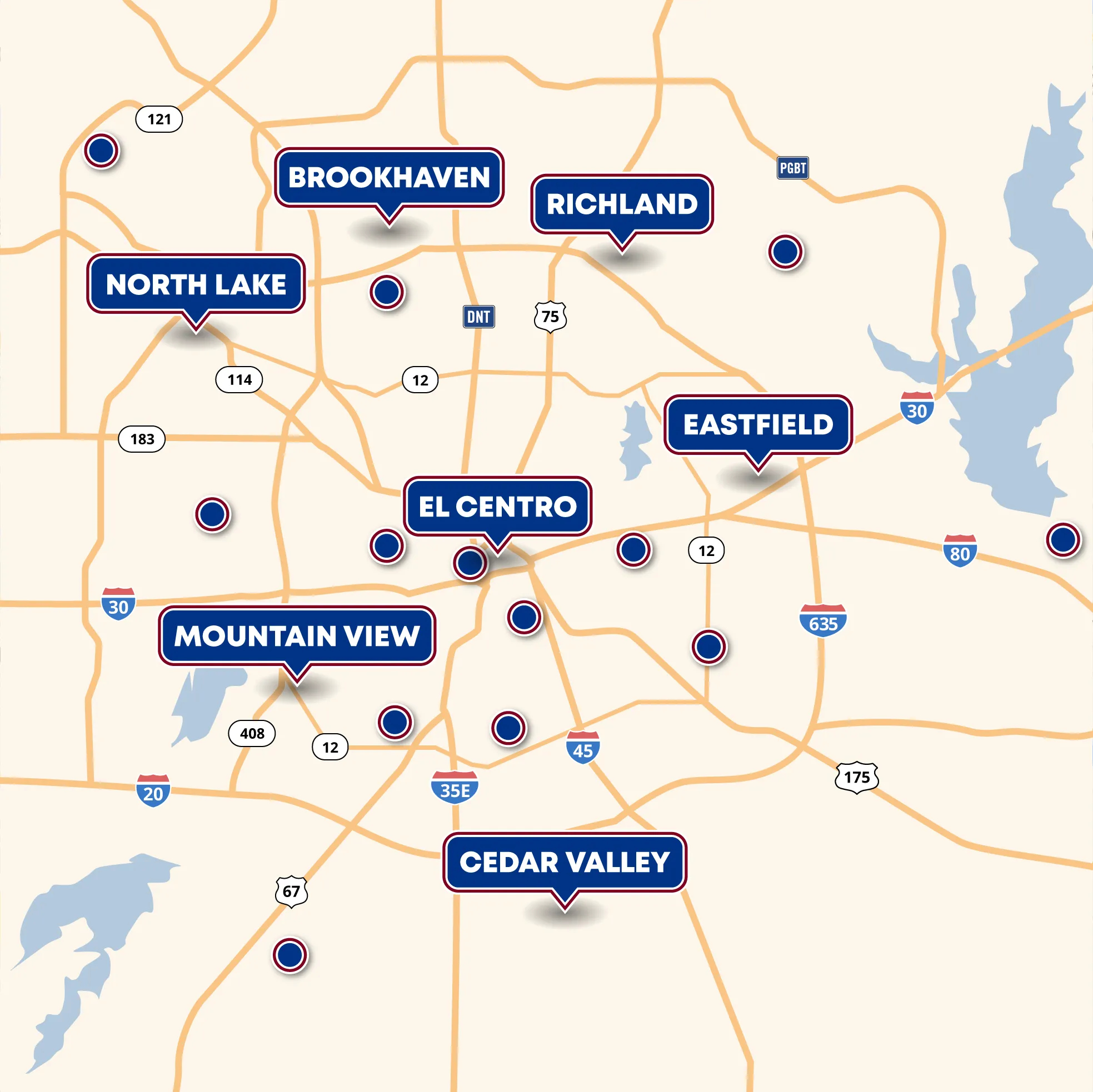
Dallas College operates seven campuses across Dallas County, with a national reach through online programs and the consortium network. The Institute draws on that footprint as its working laboratory.

Dallas College campus map showing seven campuses across Dallas County

Seven campuses. One Institute.

Brookhaven, Cedar Valley, Eastfield, El Centro, Mountain View, North Lake, and Richland. Together they serve more institutions, communities, and learners than most state university systems.

The Institute is positioned within El Centro in downtown Dallas, with planned expansion into the Knowledge District anchored by the new downtown campus. From day one, the Institute is built where the work is.

Dallas College sets the standards, and the Institute makes them shareable. What the College runs is what the Institute teaches. — Operating principle III · Tested by use
02 / Mandate

Five functions.
One register.

The Institute carries five functions. Each runs in production, mapped to the frameworks and statutes that govern the work.

I.
Education and credentialing
The Institute's AI curriculum runs in production and issues credentials of value into the workforce. Programs span literacy, certificate, associate, fellowship, and continuing education.
HB 8 Workforce
II.
Applied governance
The Dallas College AI program runs to NIST AI RMF, ISO 42001, and TRAIGA in production. The Institute maintains the control register, system cards, and the board-reported audit pack. The same standards govern every AI model running on the Dallas Twin.
NIST AI RMF ISO 42001 TRAIGA
III.
Shared services hub
The consortium is a working network of Texas member institutions. Members receive the framework, the templates, the training, and the peer benchmarking the law requires and most colleges cannot build alone.
HB 8 14 members
IV.
Research and policy
The Institute publishes the annual State of AI in Texas Higher Education report, policy briefs, and case studies from member institutions. Many draw on Dallas Twin data and modeling. The work shapes how the field thinks about AI in colleges.
Annual report Policy briefs
V.
Convening and standards
The Institute hosts the Texas Higher Education AI Convening, the Fellows Program, and the Standards Working Group. These are where the practical standards get written and adopted.
Annual convening Fellows Program
03 / Operating principles

How the Institute works.

Five principles hold across everything the Institute does. They are the part that does not flex.

I.
Mapped, not invented
Every framework, policy, and template maps to a recognized authority. Nothing the Institute publishes asks colleges to take its word for it.
NIST AI RMF ISO 42001 TRAIGA
II.
Public good first
Membership, templates, and core materials are priced for access. Most Institute publications are public. The Institute earns from the wider market, not from peers paying out.
HB 8 Open by default
III.
Tested by use
Standards published by the Institute are used by the Institute. What Dallas College runs is what the Institute teaches.
Internal first
IV.
Cleanly separated from advisory
The Institute leads publicly and sets the standards. Deeper paid engagements are delivered by a separate firm at arm's length, with full disclosure.
Chapter 171 Arm's length
V.
Built to grow
Anchored to grow into a downtown AI district at the new campus, with industry partners alongside. Built for it from the start.
Downtown Dallas
NIST AI RMF FEDERAL · STANDARDS ISO 42001 INTERNATIONAL · MGMT TRAIGA TEXAS · GOVERNANCE HB 3512 TEXAS · REPORTING Institute Framework v1.0 CONTROLS · SYSTEM CARDS · BOARD REPORTING UPDATED AS THE LAW MOVES Member institutions · Audit-ready · Board-legible DALLAS COLLEGE FIRST · CONSORTIUM NEXT
Mapping authority into operating practice · v1.0 · Updated 2026
04 / Leadership

Founding Director.

The Institute is led by a Founding Director who brings together three roles that almost never travel together: senior CIO operating experience, an active legal practice in AI and data, and formal AI training that began in graduate school in the nineties.

RP

Russ Pearlman

Founding Director · Chief Information Officer, Dallas College

Russ leads the Institute and serves concurrently as Chief Information Officer of Dallas College. He is Of Counsel at Carrington Coleman, Sloman & Blumenthal, with a practice in AI governance, technology transactions, and data privacy. He writes and speaks publicly under the name The CIO Attorney.

His 2018 article on artificial intelligence and inventorship has been cited more than one hundred times in legal scholarship, USPTO filings, and Supreme Court amici. He is the 2026 Dallas ORBIE CIO of the Year and a six-time Texas Super Lawyers Rising Star in Technology Transactions.

Education
J.D. with Honors, SMU Dedman School of Law · M.S. in Computer Science, Washington University in St. Louis
Experience
Twenty-five years across higher education, enterprise, and consulting, including Toyota, Merkle, Capgemini, and Deloitte
Governance
Faculty Advisory Council, Industry Partner Council, and Dallas College Board of Trustees oversight
Digital Twin · Dallas · In production

Dallas,
in code.

A continuously updated digital twin of the Dallas metropolitan region. Where the Institute's AI governance framework gets tested in applied use, where students and faculty do research with real data, and where civic partners model the consequences of decisions before making them.

N 32.78 W -96.80 LIVE · v2026.06
Dallas Twin · v2026.06
5
Twin layers
Spatial, workforce, population, economic, civic.
7
Civic data partners
City, county, regional, and state agencies under formal agreements.
12
AI models in production
Each governed under the Institute's framework with a public system card.
Daily
Refresh cadence
Workforce and economic layers update each business day.
01 / What it is

A working laboratory
for the region.

The Dallas Twin is the Institute's flagship applied-AI platform. It assembles the picture of the Dallas region that no single college, agency, or employer holds on its own, and it puts the Institute's governance framework into practice on real models running over real data.

Why a college builds this

Dallas College is uniquely positioned to host a regional digital twin. We sit at the intersection of workforce, civic data, and student outcomes. We have the scale to do the work and the institutional independence to do it credibly. We are the natural neutral operator.

The twin is not a marketing exercise or a vendor procurement. It is the working laboratory where the Institute's frameworks are tested, where students and faculty meet real data, and where the region's decisions get rehearsed.

What makes it different

The twin is governed under the same framework the Institute publishes to consortium members. Every model carries a system card, every dataset has a partner agreement, every output is reproducible. The same rules that govern AI at a member college govern AI inside the twin.

The result is an applied-AI platform that meets state and federal compliance from the first commit, not retroactively. That is what makes it the right home for civic decision support.

02 / The layers

Five layers, one region.

The twin assembles five distinct data layers, each maintained by the Institute under formal agreements with its data partners. Models running on the twin can draw from one layer or stitch across all five.

I.
Spatial
Streets, transit lines, buildings, utilities, and parcels across the Dallas metropolitan region. Continuously refreshed from City of Dallas, Dallas County, and NCTCOG open data. The geographic substrate on which every other layer is anchored.
City of Dallas NCTCOG
II.
Workforce
Real-time labor market signals from the Texas Workforce Commission, the Dallas Regional Chamber, and Industry Partner Council employers. Job postings, in-demand skills, credential demand, and wage signals. The layer that drives curriculum decisions at the College and across the consortium.
TWC Dallas Regional Chamber Daily refresh
III.
Population and learning
Anonymized and aggregated student outcome data from Dallas College and consortium members. Demographic context from federal and state sources. The data that lets the field see, in advance, where credentials are needed.
Anonymized Aggregate only
IV.
Economic
Regional economic indicators from the Federal Reserve Bank of Dallas, industry forecasts from the Chamber, and employer-side demand signals from the Industry Partner Council. The macro context for every workforce decision.
Dallas Fed Industry Council
V.
Civic
Selected operational data from transit (DART), public safety, public health, and emergency management, contributed by civic partners under formal data-sharing agreements. The layer that lets the twin model the consequences of regional decisions.
DART By partnership
03 / AI applications

What runs on it.

Twelve production AI models currently run on the twin. Five flagship applications drive most of the visible work. Each model is in the Institute's control register and carries a public system card.

A1
Workforce demand forecasting
Machine-learning models that project credential demand by region, sector, and time horizon. Outputs drive curriculum decisions at Dallas College and give consortium members the regional signal they need to align their own offerings.
Production Curriculum input
A2
Pathway simulation
Student-pathway models that show the likely outcomes of curricular and policy changes before they happen. Used to test catalog changes at Dallas College and to plan programs at member institutions without learning by trial.
Production Counterfactual
A3
Urban resilience scenarios
Simulations of regional response to heat events, flooding, transit disruption, and economic shocks. Produced in partnership with civic partners to support decision-making without exposing operational systems.
By partnership
A4
Policy intervention modeling
Counterfactual modeling of state and local policy changes — HB 8 effects, TRAIGA enforcement, transit changes — on regional outcomes. Inputs to the Institute's policy brief series and to public comment filings.
Policy brief input
A5
Real-time decision support
A reference layer that lets member institutions and civic partners answer specific questions against the twin. Embedded in board reporting, working sessions, and the Institute's consulting engagements.
Member access Live
The same framework that governs AI at a member college governs AI inside the twin.
Institute governance · Tested by use
04 / Governance

Tested by use.

The twin is the working proof of the Institute's framework. Every AI model on the twin is governed under the same rules the Institute publishes to consortium members. The standards we ask of others, we run on ourselves first.

G1
Public system cards
Every twin model carries a published system card describing inputs, training data, performance, limitations, and intended use. Cards are versioned and updated as models change.
Public
G2
Control register entries
Each model has a corresponding row in the Institute's control register, mapped to NIST AI RMF, ISO 42001, and TRAIGA controls. The same register the consortium framework publishes.
NIST AI RMF ISO 42001 TRAIGA
G3
Data partner agreements
Every dataset feeding the twin is governed by an explicit agreement with its source: what may be used, for how long, by whom, and with what protections. Privacy controls, anonymization, and aggregate-only requirements are documented.
Documented
G4
Quarterly audit pack
The twin's governance is reviewed each quarter and reported to the Dallas College Board of Trustees through the Institute's standard audit pack. No separate process, no separate standard.
Quarterly
G5
Public transparency
The twin's governance status, model inventory, and partner roster are public. Members and partners can see exactly which models are in production, which are in development, and which have been retired.
Open record
05 / Who uses it

The twin in practice.

The twin is not a research demo. It is a working platform with named user populations, each with their own access pattern and value from the data.

Students
Research and pathway tools. The AI Ethics Lab runs student projects against the twin. Pathway visualization helps students see the consequences of curricular choices before they make them.
Faculty
Real data in the classroom. Fellowship projects build on twin data. Coursework uses live regional signals rather than the textbook examples that go stale.
Member colleges
Regional benchmarking and workforce signal. Members can see workforce demand, credential gaps, and peer comparisons in their own service regions, drawn from the twin's continuously updated layers.
Civic partners
Decision support and scenario simulation. Agencies use the twin to model the consequences of policy changes before making them. The twin is a neutral table where regional decisions get rehearsed.
Industry
Workforce supply forecasting. Employers on the Industry Partner Council see the future credential pipeline, project hiring needs, and shape Institute curriculum against their actual demand.
The public
Open data products. The State of AI in Texas Higher Education report draws on twin data. Selected dashboards and indicators are public goods, free to anyone in the region.
06 / Civic and data partners

The institutions behind the twin.

The twin assembles data from city, county, regional, and state partners under formal agreements. Industry partners contribute compute, model infrastructure, and demand signal. The College is the neutral operator.

Civic and public partners
City of Dallas OPEN DATA · GIS
Dallas County PARCELS · DEMOGRAPHICS
NCTCOG NORTH CENTRAL TEXAS COUNCIL OF GOVS.
DART DALLAS AREA RAPID TRANSIT
Federal Reserve Bank of Dallas
Texas Workforce Commission
Industry data and infrastructure partners
Microsoft
Google Cloud
NVIDIA
Anthropic
Dallas Regional Chamber
AT&T
07 / Access

Get on the twin.

Access depends on who you are. Consortium members get baseline access as part of membership. Faculty researchers and civic partners apply for specific use cases. Industry partners enter through data and infrastructure agreements.

Members
Included in membership. All consortium tiers receive baseline twin access. T2 and T3 members get expanded query capacity and a named contact for adaptation work.
Faculty
Research access. Faculty at Dallas College and member institutions apply for twin access through a quarterly review. Approved projects publish to the Institute's research catalog.
Civic partners
Partnership inquiry. Agencies and civic organizations interested in contributing data or using the twin for decision support enter through a partnership conversation with the Institute.
Industry
Data and infrastructure partnerships. Industry partners contribute infrastructure, data, or domain expertise in exchange for workforce signal and research collaboration through the Industry Partner Council.

Work with the twin.

Civic agencies, industry data partners, and member-institution researchers can begin a conversation through the Institute. Membership in the consortium is the default path to baseline access.

Education

How we shape
higher education.

The Institute is rewriting what AI fluency looks like in Texas community colleges. Students earn it. Faculty teach it. Member institutions adopt it. Employers hire for it.

In the curriculum
01 / Student programs

Credentials of value.

A stack of programs that meets students where they are and credentials them into the AI-fluent workforce. Mapped to HB 8 outcomes, aligned with employer demand, and accepted across the consortium network.

E1
AI Literacy
A required general-education module. Every Dallas College graduate has working knowledge of how AI systems are built, how they fail, and how they shape the work they will do. The Institute licenses the module to member institutions for their own catalogs.
Required GenEd 3 credit hours
E2
AI Fluency Certificate
A 12-credit stackable certificate covering governance, applied use, and ethics, with one technical track of the student's choice. Earned alongside any Dallas College degree. Mapped to HB 8 credentials-of-value outcomes and recognized by Industry Partner Council employers.
12 credit hours HB 8 Stackable
E3
Applied AI Associate Degree
A 60-credit Associate of Applied Science designed for direct employment in AI operations, data, and applied-AI roles at North Texas employers. The curriculum is co-designed with the Industry Partner Council and refreshed annually.
AAS · 60 credits Career path
E4
Continuing Education AI Track
Short-course offerings for working professionals across North Texas. Open to non-degree learners. Aligned with the skills employers signal through the Industry Partner Council. Stackable into the Fluency Certificate for those who continue.
Open enrollment Workforce
E5
AI Ethics Lab
An undergraduate research opportunity inside the Institute. Students work alongside faculty and Institute staff on applied projects in AI governance, policy, and applied ethics. Selected projects publish in the Institute's policy brief series.
Undergraduate research Publication track
02 / Faculty programs

For the people doing the teaching.

Most discussion of AI in higher education leaves faculty either ignored or threatened. The Institute treats faculty as the lever, not the obstacle.

Cross-disciplinaryHealth sciences and applied AI
Career programsAI in clinical and technical work
In conveningFaculty across institutions
F1
Faculty AI Fellowship
A paid, year-long fellowship for faculty across all disciplines. Fellows redesign one course with AI, publish their work, and contribute to the curriculum library the Institute maintains for the consortium. Cohorts are cross-disciplinary by design.
Annual cohort Cross-disciplinary
F2
Faculty Advisory Council
A standing council of faculty from Dallas College and consortium member institutions. The Council sets the curriculum direction and reviews Institute teaching materials before they are published or licensed.
12 members Cross-institution
F3
Teaching with AI Workshops
Working sessions for faculty across the consortium on the practical questions: how to assess work in an AI-permeated classroom, how to use AI as a teaching tool, how to design coursework that holds up.
Member access Quarterly
F4
Curriculum Library
A shared, versioned library of course materials, assessment tools, and assignment templates contributed by Fellows and Advisory Council members. Free to member institutions. Updated continuously.
Member access Versioned
03 / Research and policy

How the work shapes the field.

The Institute publishes research, policy, and benchmarking work that other institutions cite, regulators read, and the press follows. The annual report is the field's reference point on AI in Texas higher education.

R1
State of AI in Texas Higher Education
The Institute's annual report. Survey data from member institutions and observers, framework adoption rates, faculty sentiment, student outcomes, and a forward look at the year ahead. Released each June.
Annual 41 institutions surveyed
R2
Policy Brief Series
Short publications on specific policy questions: TRAIGA implementation, HB 3512 reporting, AI in financial aid, AI in admissions, vendor governance, faculty academic freedom in an AI-permeated context. Written for boards, presidents, and policy staff.
Quarterly Public
R3
Member Case Studies
Documented implementations from consortium members. How a college rolled out the framework, what worked, what did not, what the board asked, what changed. Anonymized when needed. Always written for use, not for show.
Member-contributed Public
R4
Regulatory Commentary
The Institute files public comments on Texas DIR rulemaking, federal AI policy, and accreditor guidance affecting higher education. Comments draw on member experience and the Institute's own program data.
Public record Member-informed

Bring the curriculum to your institution.

Consortium membership includes licensed access to the Institute's curriculum library, the AI Literacy module for adaptation, and the Faculty Advisory Council network. New members onboard at the start of each semester.

Services

What the Institute
produces.

Five service areas. Each runs first at Dallas College and is then offered to consortium members. The materials are versioned, mapped, and ready for board review.

In production
Catalog

Service register.

What gets delivered, who it serves, and the authority it maps to.

S1
Governance framework and controls
The Institute's governance framework, control register, system card templates, and board reporting pack. Used in production at Dallas College and licensed to consortium members. Versioned and updated as the law moves. Currently at v1.0.
NIST AI RMF ISO 42001 TRAIGA
S2
Compliance and statutory reporting
The compliance pack: board memo templates, audit trails, public disclosures, and the working notes that walk a college through HB 3512 and TRAIGA without legal counsel on every question.
HB 3512 TRAIGA
S3
Curriculum library
The full Institute curriculum library: the AI Literacy module, Fluency Certificate materials, Faculty Fellowship-contributed coursework, and the assessment tools to back them. Member institutions adapt and run the materials in their own catalogs.
HB 8 Member access
S4
Fellows program
The Fellows Program convenes a cohort of higher education leaders for a year of structured work on AI governance, ethics, law, and compliance. Differentiated from implementation-focused alternatives by depth on the parts implementation cannot reach.
Annual cohort Higher ed
S5
Convening and benchmarking
The Texas Higher Education AI Convening runs annually in Dallas. Peer benchmarking circulates among member institutions on a continuous basis. The Standards Working Group meets quarterly to produce the next round of shared standards.
Annual summit Standards Working Group

Need something more than membership?

Deeper, custom engagements are delivered by Pearlman Morris, the Institute's affiliated advisory firm, in strategic alliance with Carrington Coleman, Sloman & Blumenthal. The Institute and the firm are separately staffed, separately funded, and structured at arm's length.

Consortium

Shared services.
Real standards.

An annual subscription that gives a Texas college the governance framework, the curriculum library, the training, and the reporting tools to meet state obligations without building its own AI office.

Across Texas
01 / Included with membership

What members get.

Everything below is delivered as part of the annual subscription. Institution-specific engagements are quoted separately.

M1
AI governance framework
The full framework, mapped to NIST AI RMF, ISO 42001, and TRAIGA. Updated by the Institute and pushed to members as the law moves. Currently at v1.0.
v1.0
M2
Curriculum library
Access to the Institute's full curriculum library: AI Literacy module, Fluency Certificate materials, Fellowship-contributed coursework, assessment tools. Adapted to your catalog with Institute support.
HB 8 Adaptation support
M3
Model policies and templates
Board policy templates, employee standards of conduct, faculty syllabus language, vendor governance language. Members receive the full library at onboarding and updates on a rolling basis.
Templates
M4
Statutory compliance pack
HB 3512 and TRAIGA materials, including the public-facing disclosures, internal audit trails, and the process notes that explain how Dallas College meets each obligation.
HB 3512 TRAIGA
M5
Staff and faculty training
Role-based AI awareness and governance training, plus faculty access to the Teaching with AI workshop series. Delivered online with an annual cohort working session.
Online + cohort
M6
Board reporting tools
Quarterly dashboards and memo templates that translate the AI program for trustees. Designed to be read once and understood. In active use at Dallas College.
Quarterly
M7
Peer benchmarking
Anonymized peer data across member institutions on adoption, controls, and incidents. Circulated semi-annually and discussed at the annual convening.
Semi-annual
02 / Tiers

Membership tiers.

Pricing is tiered to institution size. Membership contracts are held through Dallas College Enterprise Ventures.

Tier
Institution profile
Notes
Annual
T1
Small or rural
Under 5,000 FTE
Access pricing for institutions in the HB 8 shared-services lane. Full framework and templates.
$25,000per year
T2
Mid-size regional
5,000 – 25,000 FTE
Full materials, one annual working session, and curriculum-library access.
$50,000per year
T3
Large or multi-campus
25,000+ FTE
Full materials, two working sessions, named contact, and priority adaptation support.
$75,000per year
03 / Beyond membership

Project work and custom engagements.

Membership covers the framework, the templates, the training, and the standing materials. For deeper, institution-specific work, the Institute and its affiliated advisory partners take on per-project engagements priced to scope.

P1
Implementation engagements
Hands-on adaptation of the framework, policies, and training to a specific institution. The Institute or its affiliated advisory partners run these as scoped projects, typically eight to sixteen weeks. Pricing is set per project.
Scoped project 8–16 weeks
P2
Compliance and audit support
Targeted support for HB 3512 filings, TRAIGA readiness reviews, and audit response. Scoped to the institution's specific position and deadline. Per-project fees.
HB 3512 TRAIGA
P3
Curriculum adaptation
Faculty-led work to adapt the AI Literacy module, the Fluency Certificate, or the Applied AI Associate curriculum to a member institution's catalog and faculty capacity. Priced per program adopted.
Per program Faculty-led
P4
Board and executive briefings
Half-day or full-day sessions for boards, presidents, and senior executive teams on the AI governance landscape and the specific actions required at the institution. Priced per engagement.
Half-day · Full-day

Custom and project work for member and non-member institutions is delivered by the Institute or by Pearlman Morris, the Institute's affiliated advisory firm in strategic alliance with Carrington Coleman, Sloman & Blumenthal. The Institute and the firm are separately staffed, separately funded, and structured at arm's length, with full disclosure on every engagement.

Join the consortium.

New members onboard at the start of each semester. The intake process takes about four weeks from initial conversation to access.

Resources

Reports, frameworks,
and tools.

The Institute publishes the field's reference materials and shares the working documents that explain how the program is built.

Published 2026
01 / Reports

Institute reports.

The annual report and the policy brief series. Read by colleges, regulators, and the press.

Annual Report
State of AI in Texas Higher Education, 2026
Survey data from 41 institutions · Released Jun 2026
Read →
Policy Brief
TRAIGA at One Year: What Texas Colleges Need to Know
Q2 2026 brief
Read →
Policy Brief
AI in Financial Aid Workflows: Risks, Controls, and What Auditors Will Ask
Q1 2026 brief
Read →
Concept
The Governance Dividend: AI Governance as a Capital Discipline
Founding paper
Read →
02 / Frameworks and tools

Working materials.

Published, versioned, and mapped to recognized authorities. Available to consortium members as part of membership.

Framework
AI Governance Framework, v1.0
Mapped to NIST AI RMF, ISO 42001, TRAIGA
Members →
Tool
AI Control Register and System Card Templates
Excel and Word, used in production
Members →
Tool
Board Reporting Pack
Quarterly dashboards and memo templates
Members →
Curriculum
AI Literacy module · Faculty edition
Adaptation guide and assessment tools
Members →
03 / Public record

Filings and commentary.

Selected public-record items the Institute has contributed to.

Filing
Public comments on TRAIGA rulemaking, Texas DIR
Filed Feb 2026
Read →
Press
The Institute and its work, in the national press
New York Times, Puck News, and more
Read →